At a glance
Key takeaways
- Publish curated, well-understood requests rather than exposing the internal backlog.
- Treat votes as evidence alongside customer impact, strategy, confidence, effort, and risk.
- Use explicit statuses and notify affected customers when a roadmap decision changes or ships.
What a public roadmap tool should actually do
A public roadmap tool for feature requests should not be a decorative list of ideas. It should help your team decide what to build and help customers understand what is happening next.
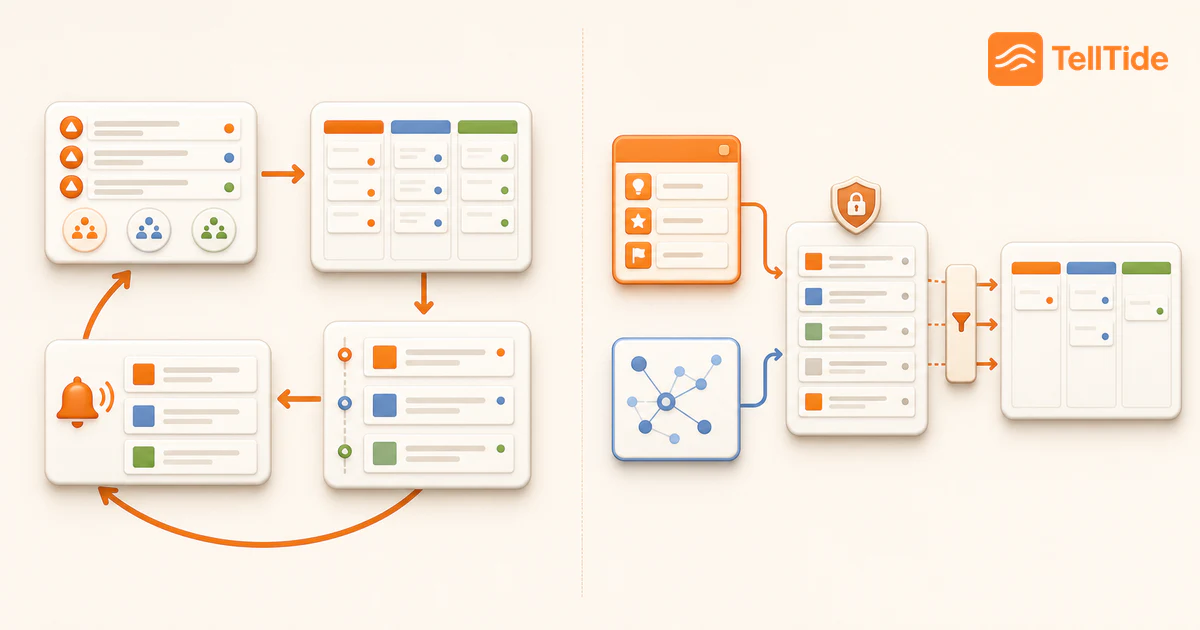
The highest-value roadmap workflows connect three things: private feedback from users, public voting from customers, and internal product decisions. If those systems are disconnected, your team ends up copying requests between tools and customers never see progress.
A clean feature request workflow
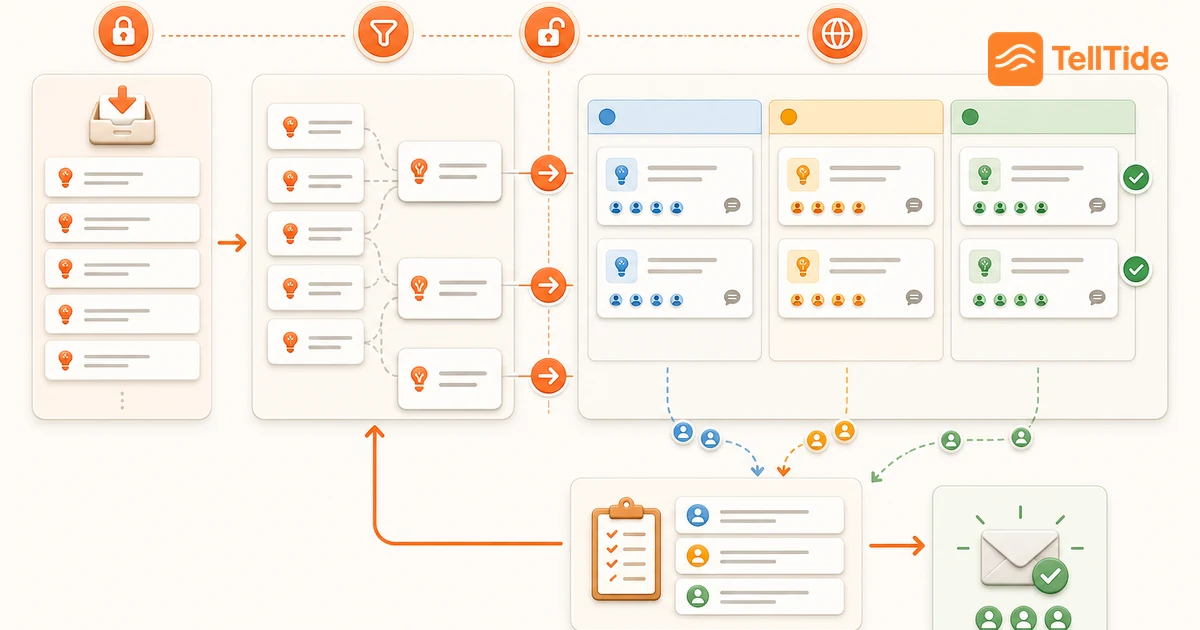
A practical workflow starts with intake. Users submit feature requests through a feedback widget, support conversation, API endpoint, or dashboard form. The product team then triages duplicates, clarifies the request, and decides whether it belongs on the roadmap.
Once an idea becomes public, users can vote and comment. The team can move the item through statuses such as Received, Planned, In Progress, and Shipped. That status language matters because it sets expectations without promising dates too early.
- Collect: capture requests from the product moment, not only from support tickets.
- Triage: merge duplicates, add context, and reject requests that do not fit strategy.
- Publish: expose the right ideas on a public board with clear language.
- Measure: watch votes, comments, customer segments, and repeat requests.
- Close: update status and tell users when a request ships.
How to prioritize roadmap votes without becoming vote-driven
Votes are signal, not strategy. A roadmap voting tool tells you what customers are asking for, but it should not replace product judgment.
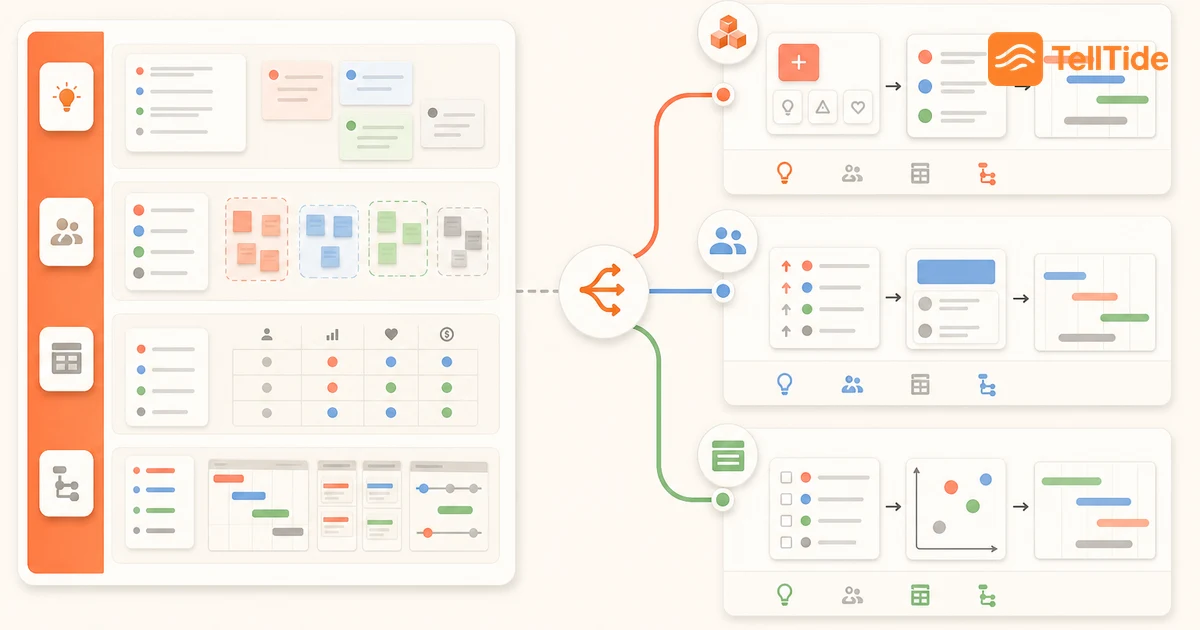
A small number of enterprise customers asking for a workflow blocker may matter more than a popular but low-impact idea. Treat votes as one input beside revenue impact, retention risk, support volume, engineering cost, and product direction.
| Signal | What it tells you | Risk if used alone |
|---|---|---|
| Votes | How many users care enough to click. | Popularity can overpower strategic fit. |
| Comments | Why users want the feature and what outcome they expect. | Loud users may not represent the market. |
| Feedback source | Whether requests come from prospects, free users, or paying customers. | Segments can be misread without context. |
| Support volume | How often the missing feature creates friction. | Support pain may reflect onboarding gaps, not product gaps. |
| Revenue impact | Whether the request affects expansion, churn, or conversion. | Revenue alone can bias the roadmap toward the largest accounts. |
Use roadmap language customers can trust
The public roadmap should avoid vague statuses such as Maybe or Soon. Customers read those words as promises. Use statuses that describe the team state: Received, Under Review, Planned, In Progress, Shipped, or Declined.
When you decline an idea, explain why in plain language. That can build more trust than silently hiding requests. Customers understand tradeoffs when the reasoning is direct and respectful.
How TellTide connects feedback to the roadmap
TellTide keeps the workflow tight: collect feedback with the widget or API, triage submissions in the inbox, then manage public roadmap items where users can vote and comment.
Customers can use that public view to check the status of a request. Whether it improves conversion, retention or support volume needs measurement in your own product; this guide does not claim a demonstrated uplift.
Choose the public surface your team can maintain
Start by separating three requirements. A voting board lets customers discover and discuss requests. A roadmap communicates selected work and status. A changelog announces what has shipped. A vendor may bundle them, but each has a different owner and maintenance obligation.
For a trial, ask a colleague to locate a request, explain its current status and find what changed after release. Record where they become uncertain. If your team needs subscribed release announcements, check notification behavior explicitly; a status column alone will not meet that requirement.
TellTide provides a curated public roadmap with votes and comments. It should not be selected on an assumption of a built-in changelog or automated release emails. Compare the Upvoty alternatives if the broader release loop is essential.
Put this into practice: See the live roadmap
Questions teams ask before choosing this workflow
What is a public roadmap tool?
A public roadmap tool lets customers view, vote on, and follow product ideas or planned features. Product teams use it to communicate priorities and gather demand signals.
Should product teams build every highly voted feature?
No. Votes are useful demand signals, but they should be weighed against customer segment, revenue impact, product strategy, support volume, and implementation cost.
Can TellTide turn feature requests into roadmap items?
Yes. TellTide collects feature requests through the widget or API, lets teams triage them in the inbox, and supports public roadmap voting and comments.

Abhijith
Founder of TellTide, writing practical guides about product feedback, feature requests, and public roadmap workflows for SaaS teams.