
At a glance
Key takeaways
- Capture the outcome the customer wants, not only the feature name they suggested.
- Use votes as one signal beside customer impact, frequency, strategy, and effort.
- Keep the private inbox broader than the public roadmap.
Why feature requests get messy so quickly
The same idea arrives in five different forms: a support ticket, a sales note, an email, an in-app message, and a roadmap comment. If each channel becomes its own backlog, nobody knows whether demand is growing or simply being duplicated.
The other problem is language. Customers naturally suggest a solution. Your job is to understand the job they are trying to finish, who is affected, and what happens today when the capability is missing.
A simple feature request management workflow
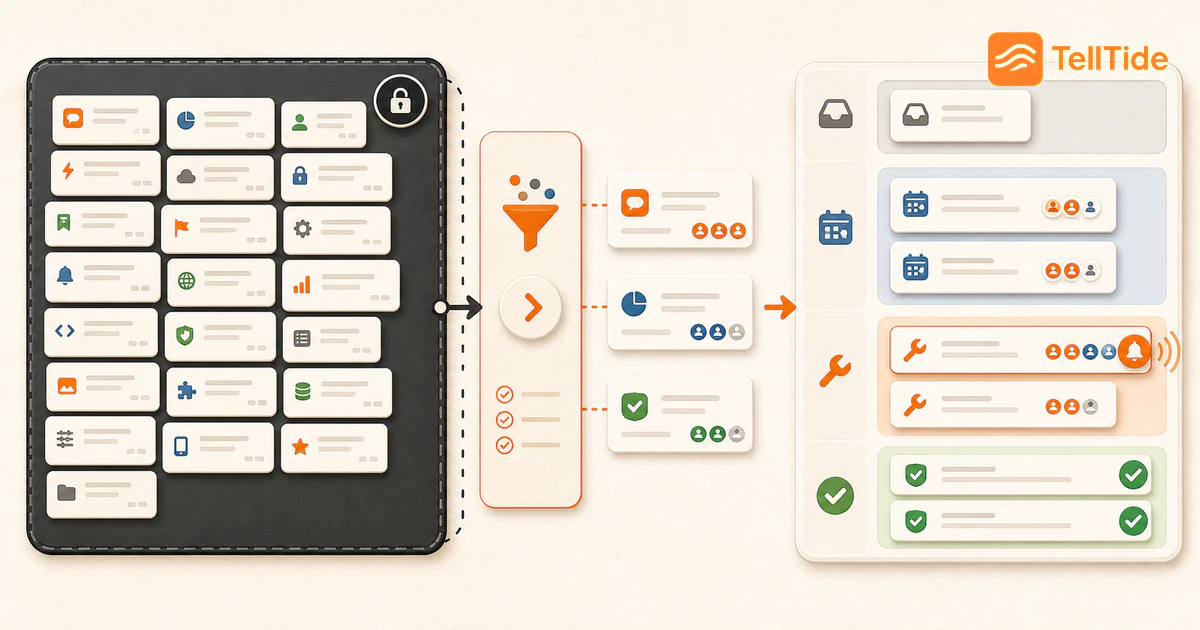
- Capture every request in one inbox with the original customer wording and context.
- Clarify the problem, expected outcome, urgency, and current workaround.
- Group requests that describe the same underlying need.
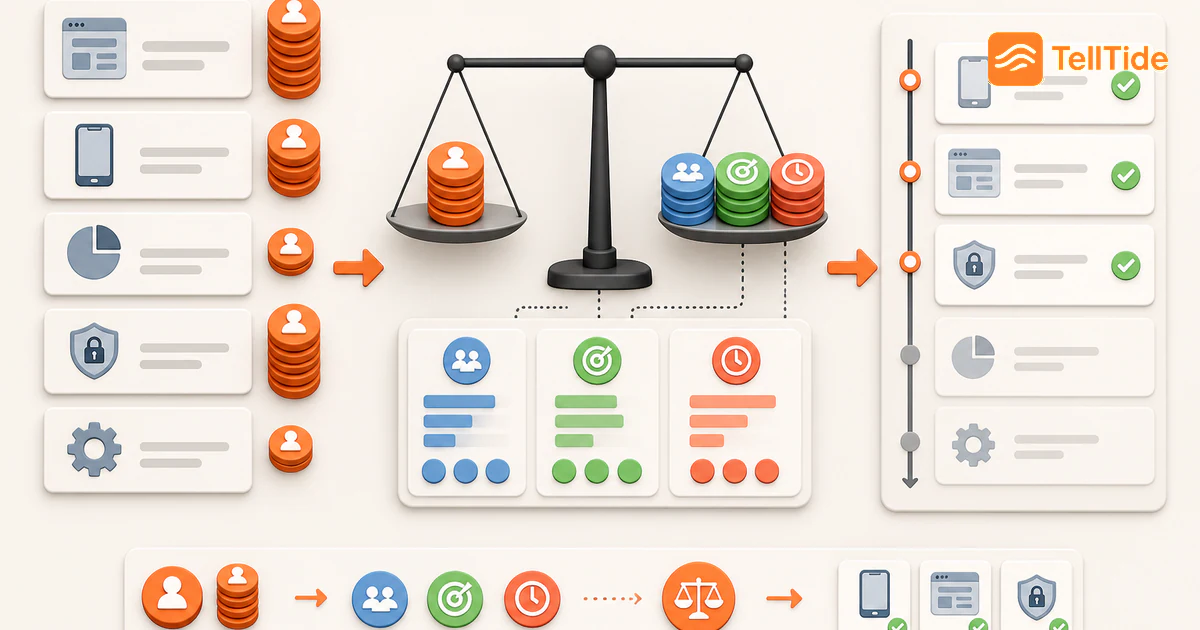
- Evaluate demand alongside strategy, customer impact, retention risk, and effort.
- Publish only requests that are useful for wider validation or roadmap communication.
- Update the status when the idea is received, planned, in progress, shipped, or declined.
How to prioritize feature requests fairly
Fair does not mean “most votes wins.” It means using the same questions for every request. A feature with ten votes from casual users may matter less than a workflow blocker affecting three long-term customers. A popular idea may also pull the product away from its purpose.
Write down the criteria your team trusts and keep them simple enough to use. For a small SaaS, customer impact, frequency, strategic fit, confidence, and effort are usually enough to start.
| Signal | Question to ask |
|---|---|
| Customer impact | What becomes possible or less painful if we solve this? |
| Frequency | How often does the problem appear across customers and workflows? |
| Strategic fit | Does solving it strengthen the product we are trying to build? |
| Confidence | Do we understand the problem well enough to choose a solution? |
| Effort | What is the smallest useful version and its ongoing cost? |
How to manage feature requests in TellTide
Enable the Feature request category in the TellTide widget so users can describe ideas without mixing them with bug reports or reviews. New requests appear in the Features view of the inbox, where you can search, review context, and update status.
When a request is ready for wider visibility, show it on the public roadmap and place it in the appropriate roadmap stage. Customers can then vote and comment while your team keeps control of the decision.
Example: group requests by problem, not wording
“Add CSV scheduling,” “email my report every Monday,” and “automate exports” may look like three features. They may all express the same job: a manager needs fresh data delivered without repeating a manual task. Grouping by that problem gives the team a better unit of analysis while preserving each customer’s wording and context underneath.
Before prioritization, verify whether the reporters share the same required outcome. One customer may need a personal reminder; another may need an auditable team distribution workflow. If the needs differ materially, keep separate problem clusters even when the proposed solution sounds similar.
What every request record needs
- a plain-language problem statement;
- links to the original submissions and affected accounts;
- evidence about frequency, severity, and current workarounds;
- the customer segments and product areas involved;
- an owner, status, and next decision date; and
- a record of what the team decided and why.
Do not convert every request into an engineering ticket. Create delivery work only after the problem has been understood and selected. That separation keeps the request system useful for discovery and the issue tracker useful for execution.
A request can be important without being ready to build
Consider an illustrative request for “a dashboard for every client.” Ask who needs access, what information they must see, and what is wrong with the current sharing method. A new dashboard, a saved view and a scheduled report solve different versions of that request.
Record three states separately in your working notes: evidence collected, decision made, and delivery work created. A popular item can still need research; an accepted problem can still have an undecided solution. This avoids translating customer wording directly into an engineering specification.
Preserve links to individual submissions when you group them. Treat grouping, ownership and review dates as a team process unless your tool explicitly supports those fields. TellTide's inbox search and statuses support review; this guide does not promise automatic duplicate merging or scoring. See how to interpret feature votes.
Put this into practice: Get Pro
Questions teams ask before choosing this workflow
What is feature request management?
Feature request management is the process of collecting customer ideas, clarifying the underlying need, grouping related requests, prioritizing them, and communicating decisions.
Should every feature request go on a public roadmap?
No. Keep the intake inbox broad and publish only requests that are clear, appropriate for public discussion, and useful for validation or communication.
How do I track feature requests without a spreadsheet?
Use a feature request tool with structured intake, searchable inbox states, voting, and a public roadmap so context and progress stay connected.

Abhijith
Founder of TellTide, writing practical guides about product feedback, feature requests, and public roadmap workflows for SaaS teams.