At a glance
Key takeaways
- TellTide suits lean teams that want a quick widget or API workflow with fewer operational layers.
- UserVoice suits established feedback programs that rely on customer segmentation, scoring, and delivery integrations.
- Your team size and feedback volume matter more than the number of features on a comparison page.
Publisher disclosure: TellTide publishes this comparison. Vendor descriptions are based on public documentation, not a hands-on benchmark. TellTide requires a Pro subscription; it does not include a built-in changelog, automated email notifications or ready-made integrations.
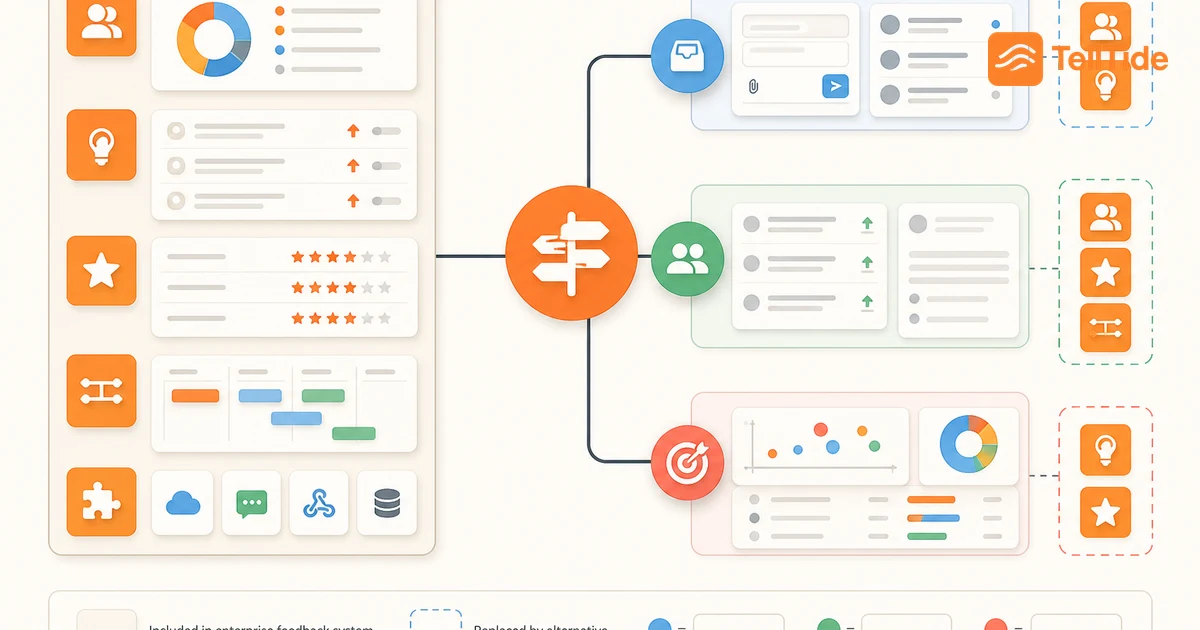
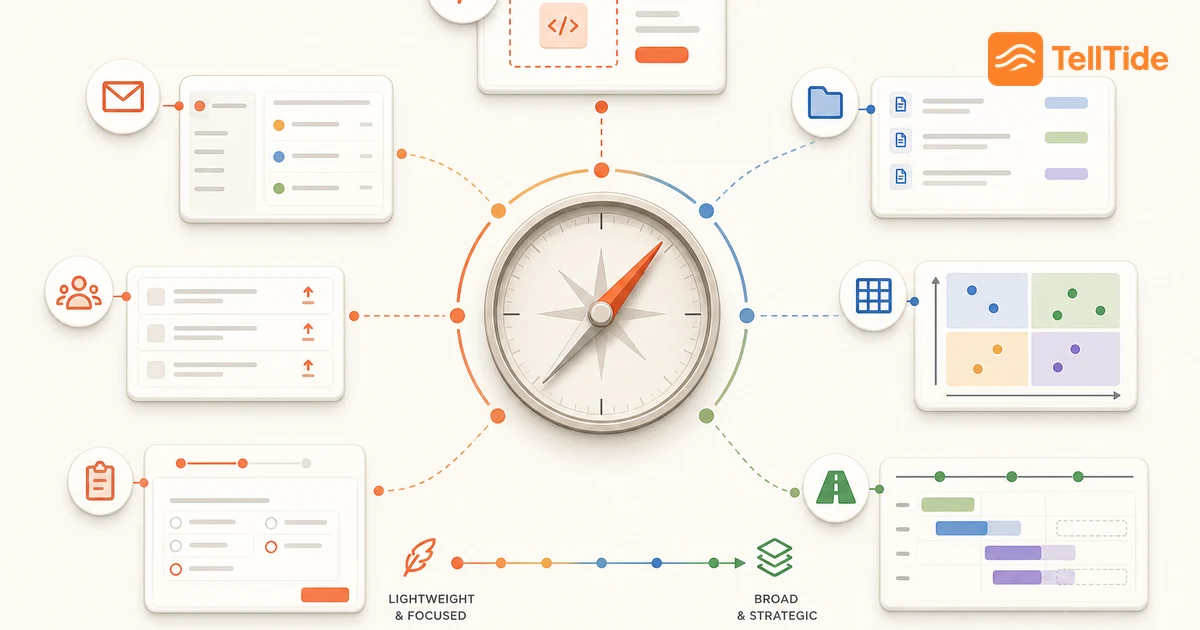
Enterprise feedback governance or a lightweight collection loop?
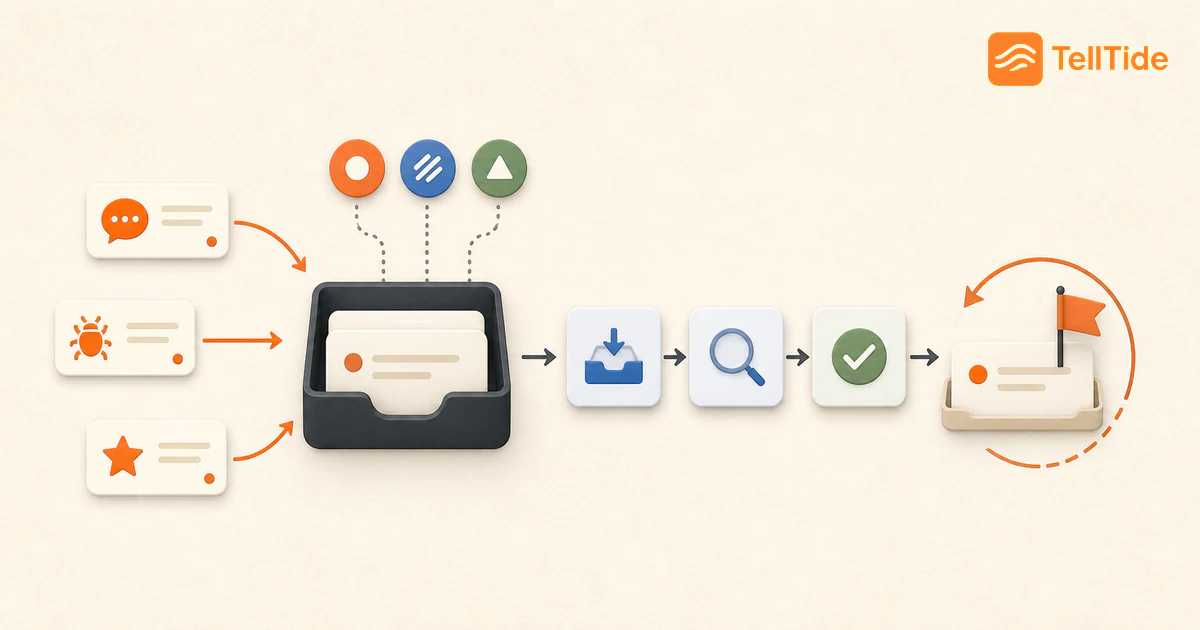
Choose TellTide when your immediate problem is scattered product feedback. It gives customers a simple in-product entry point, sends structured submissions to one inbox, and lets the team publish the strongest feature requests to a public roadmap.
Choose UserVoice when your product organization needs a formal discovery system. UserVoice connects ideas with voter, user, and account data; supports segments and scoring; and can link roadmap work with tools such as Jira or Azure DevOps. That makes it a better match for a mature B2B feedback operation.
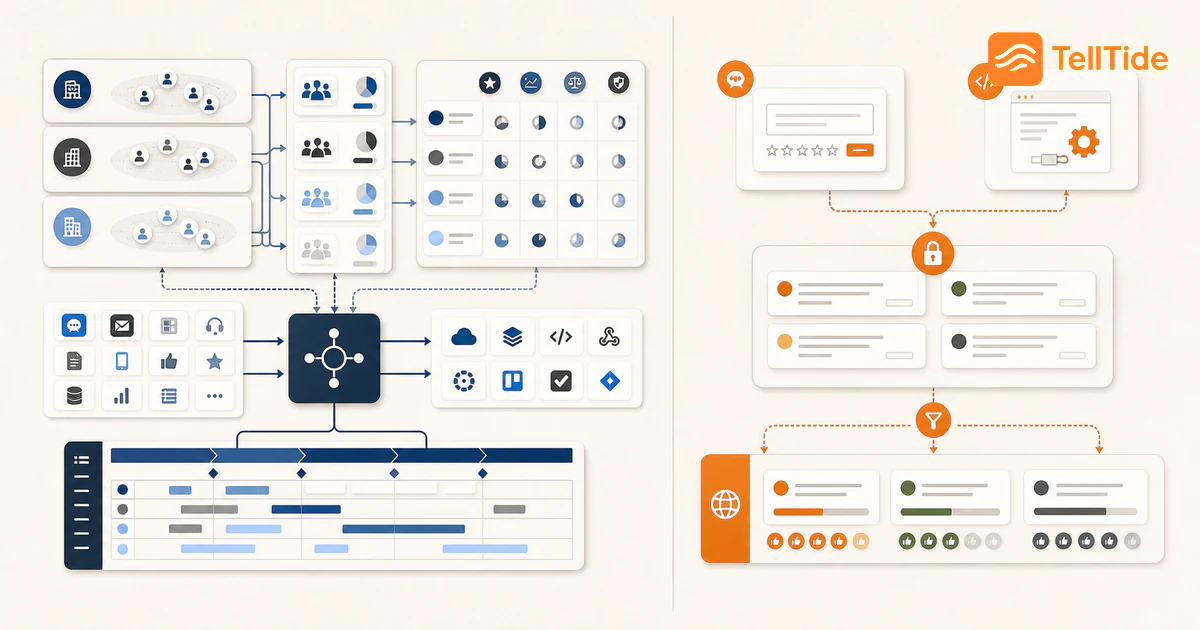
UserVoice’s account intelligence compared with TellTide
| Capability | TellTide | UserVoice |
|---|---|---|
| Primary workflow | Structured capture → inbox triage → public roadmap | Ideas and qualitative feedback → customer analysis → roadmap and delivery |
| Customer context | App, feedback type, source, message, and submitted details | User and account data, segments, voters, comments, and custom fields |
| Prioritization | Statuses, filters, roadmap votes, and direct product judgment | Custom scores, segments, linked evidence, and product-area views |
| Planning | A customer-facing roadmap for selected requests | Internal roadmap features linked to ideas and delivery tools |
| Best fit | Startups and compact SaaS teams | B2B product organizations with formal discovery processes |
Choose TellTide when you want one clear feedback habit
A small team rarely needs a complex taxonomy on day one. TellTide lets you begin with four understandable inputs—reviews, bugs, feature requests, and general feedback—then filter and act from a shared inbox. It is enough structure to keep feedback useful without turning setup into its own project.
It also separates private intake from public planning. Customers can report a bug without publishing it to a community, while worthy feature requests can move to the roadmap when the team is ready to discuss them openly.
Choose UserVoice when customer context drives prioritization
UserVoice becomes more valuable when the same request means different things for different accounts. Product teams can examine voters, qualitative feedback, customer segments, and custom scores before turning an idea into roadmap work. That is especially useful when sales, success, support, and product all contribute to discovery.
If you already need that governance, the broader system can reduce manual analysis. If you are still trying to make feedback collection consistent, TellTide gives you a shorter route from user message to a visible product decision.
Test the governance you will actually maintain
Use a representative set of B2B requests from accounts of different sizes. In UserVoice, test the segmentation, evidence, portal, and internal analysis workflows that would influence your decisions. Confirm which customer and account attributes reach the feedback record, how duplicates are handled, and how product managers turn demand into a roadmap decision.
In TellTide, test the focused path: submit through the widget or API, review privately, search related messages, and publish only the request that benefits from public votes and comments. Check whether the absence of a heavier research and governance layer is a limitation or welcome simplicity.
Migration effort should include more than importing titles and votes. Preserve the original customer context, consent expectations, comments, statuses, ownership, and the reason behind past decisions. A product-feedback system loses much of its value if the evidence trail is reduced to a spreadsheet of request names.
Keep account evidence attached to the buying decision
UserVoice currently describes a customer-intelligence platform that connects fragmented signals with revenue-weighted insights. This is a broader requirement than a suggestion box. During evaluation, trace one important account request back to the original customer evidence rather than judging only the summary.
Ask who maintains account identifiers, how changing contracts affect the analysis and which team validates a recommendation. A revenue-weighted view is only useful if the underlying association is correct. These are evaluation questions, not evidence that UserVoice has an identified data defect.
TellTide does not claim equivalent revenue intelligence or CRM integrations. Use the UserVoice alternatives guide to decide whether that capability can be removed from your process before changing products.
Put this into practice: Get Pro
Questions teams ask before choosing this workflow
Is TellTide a UserVoice alternative?
TellTide is an alternative for teams that need feedback capture, inbox triage, and a public roadmap without a full enterprise discovery program.
Which tool is better for customer segmentation?
UserVoice is built for deeper user and account segmentation. TellTide focuses on a simpler app- and feedback-type-based workflow.
Can TellTide collect feedback outside a website?
Yes. Its API can receive submissions from mobile apps, desktop apps, backend services, or custom forms.
Research notes
Sources reviewed
These references support the discussion above. Specific pricing checks are dated in the article; its editorial update date does not imply that every linked page was reverified. Confirm plan availability with each vendor.

Abhijith
Founder of TellTide, writing practical guides about product feedback, feature requests, and public roadmap workflows for SaaS teams.