At a glance
Key takeaways
- Choose TellTide when you want structured feedback capture and private triage without adopting a larger product feedback system.
- Choose Canny when public feedback boards, advanced prioritization, segmentation, and changelog communication are central to your process.
- Both can support feature requests and roadmaps, but they start from different places.
Publisher disclosure: TellTide publishes this comparison. Vendor descriptions are based on public documentation, not a hands-on benchmark. TellTide requires a Pro subscription; it does not include a built-in changelog, automated email notifications or ready-made integrations.
Community feedback board or private multi-type inbox?
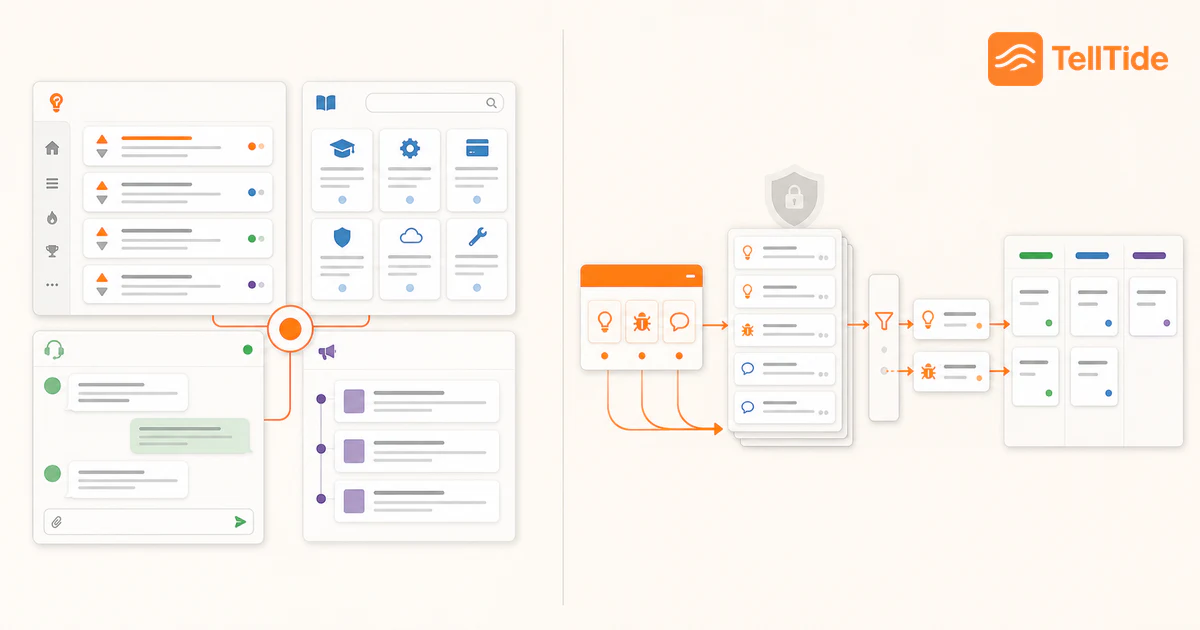
TellTide is the cleaner fit for a small SaaS team that wants to collect reviews, general feedback, bug reports, and feature requests through an embedded widget or API. Submissions enter a private inbox, and the team decides which requests deserve a place on the public roadmap.
Canny is the stronger fit when the feedback board itself is a customer destination. Its workflow covers posts, votes, comments, user segmentation, prioritization, public or private roadmaps, and changelog updates. That broader scope is useful when feedback operations already play a large role in product planning.
Where Canny’s community workflow differs from TellTide
| Capability | TellTide | Canny |
|---|---|---|
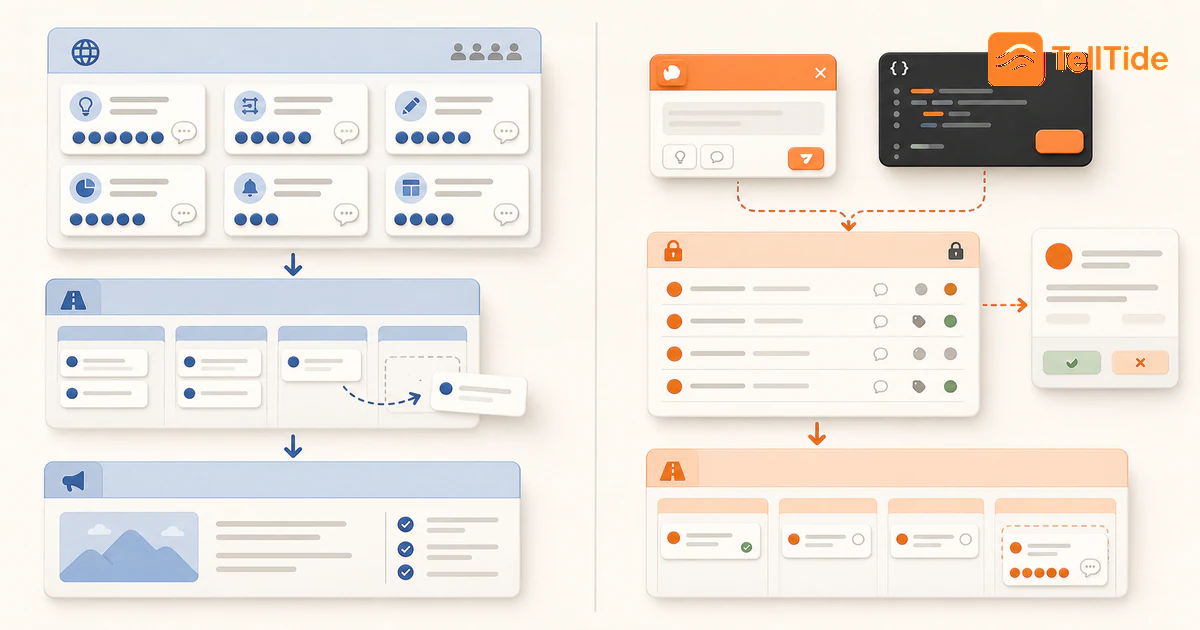
| Primary workflow | Widget or API → private inbox → selected public roadmap items | Feedback boards → voting and analysis → roadmap → changelog |
| Feedback capture | Structured reviews, bugs, feature requests, and general feedback | Posts, votes, comments, integrations, and feedback entered on behalf of users |
| Prioritization | Inbox filters, statuses, roadmap votes, and team judgment | Segmentation, custom fields, scoring, vote analysis, and customer context |
| Customer-facing area | Curated public roadmap with votes, comments, and statuses | Public or private boards and roadmaps plus product announcements |
| Best fit | Lean SaaS teams that want a focused feedback loop | Teams running a mature, community-led feedback program |
Choose TellTide when feedback should start inside your product
TellTide keeps the first step simple: place the feedback launcher on your site, choose the feedback categories you want, and let users describe the experience while it is fresh. If a widget does not fit, the API can send feedback from a mobile app, desktop app, or custom form into the same workflow.
The private-first model is helpful when you do not want every raw message to become a public idea. Your team can review bug reports and general comments privately, then publish only qualified feature requests to the roadmap. That keeps the public view useful without asking users to understand your internal backlog.
Choose Canny when the feedback community is part of the product process
Canny makes more sense when customers need a searchable board where they can post, vote, and discuss ideas—and when your team wants deeper ways to segment and score that demand. Its roadmap and changelog also make release communication a natural continuation of the same workflow.
The practical question is whether your team will use that additional operating layer. If you need a strong community feedback destination and detailed product analysis, Canny earns its wider scope. If you mainly need reliable capture, triage, and a curated roadmap, TellTide stays closer to the job.
Run a workflow test before choosing
Evaluate both products with the same five realistic submissions: a vague bug report, a private account complaint, two duplicate feature requests from different customer segments, and a positive review. Ask the team to capture each message, find the relevant customer context, combine related demand, make a priority decision, publish one suitable request, and communicate a status change.
The result exposes the operating difference more clearly than a feature checklist. In Canny, pay attention to how much value your team gets from boards, segmentation, prioritization, and release communication. In TellTide, test whether the shorter widget-or-API to private-inbox to selected-roadmap path covers the work you actually do.
Also estimate ownership after launch: who moderates public posts, maintains fields, responds to comments, and keeps roadmap or changelog states accurate? Choose the system your team can operate consistently, not the one with the longest capability list.
Budget for participation, not only the subscription
Canny's pricing lists a free tier and paid plans based on tracked users. Check how customers recorded through imports, votes or automated capture affect that count. A trial with only employees will not reveal the cost of a real customer feedback program.
Canny also supports private boards and embedded capture. TellTide's distinction is the separation of reviews, bugs and requests before curated publication; it is not exclusive access to privacy or widgets. TellTide requires a Pro subscription.
If your decision depends on consolidating customer signals, verify which existing support sources are covered by your chosen Canny plan. If you just need structured intake, see Canny alternatives by workflow.
Put this into practice: Get Pro
Questions teams ask before choosing this workflow
Is TellTide a Canny alternative?
Yes, for teams that need structured feedback capture, a private inbox, and a public roadmap. Canny covers a broader feedback-board, prioritization, and changelog workflow.
Does TellTide have feature voting?
Yes. Teams can publish selected requests to a public roadmap where users can vote and comment.
Which is better for a small SaaS team?
TellTide is likely the simpler fit when a small team wants fast setup and private triage. Canny may fit better when a public feedback community and deeper prioritization are already core requirements.
Research notes
Sources reviewed
These references support the discussion above. Specific pricing checks are dated in the article; its editorial update date does not imply that every linked page was reverified. Confirm plan availability with each vendor.

Abhijith
Founder of TellTide, writing practical guides about product feedback, feature requests, and public roadmap workflows for SaaS teams.