At a glance
Key takeaways
- TellTide is a focused feedback workflow, not a replacement for a complete product planning system.
- Productboard fits organizations that want Spark to synthesize connected evidence, draft product work, and support prioritization and roadmaps.
- Choose based on whether you need to operate a feedback loop or maintain an AI-assisted discovery and planning system.
Publisher disclosure: TellTide publishes this comparison. Vendor descriptions are based on public documentation, not a hands-on benchmark. TellTide requires a Pro subscription. It emails you about new feedback, emails the submitter when their item's status changes or gets a reply, and can post the same events to Slack or a signed webhook. Its public roadmap has a changelog of shipped items with short release notes, but there are no announcement posts or integrations with tools like Jira or Linear.
Agentic product system or focused feedback layer?
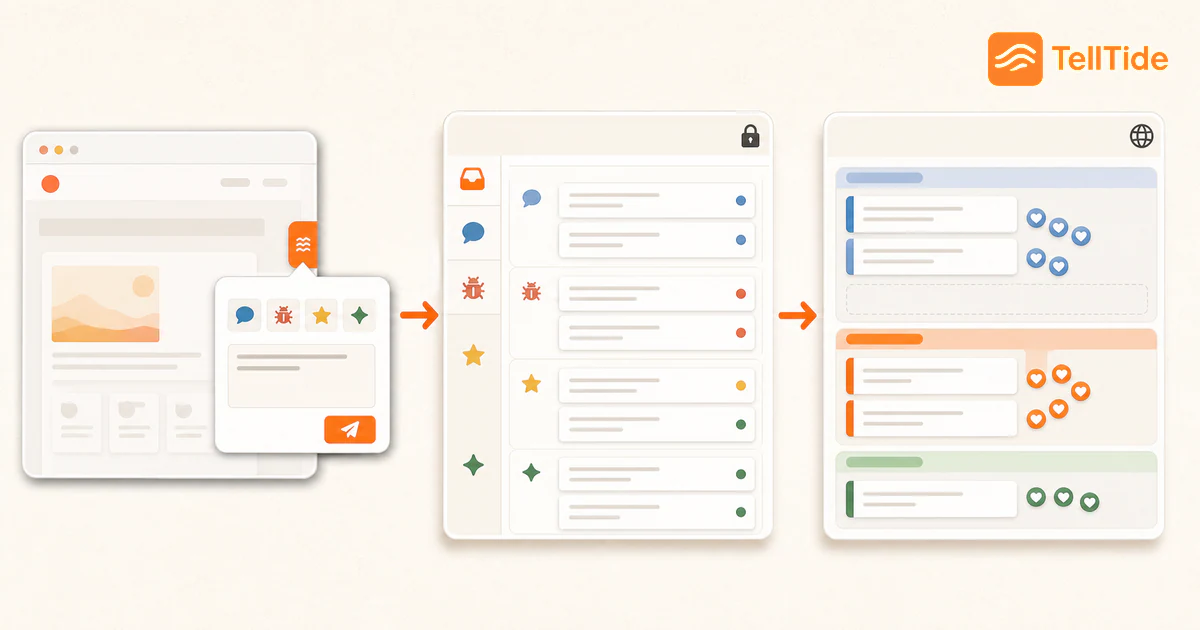
TellTide is for teams that want an approachable customer feedback tool: embed a widget or use the API, review structured submissions in an inbox, and make selected feature requests visible on a public roadmap.
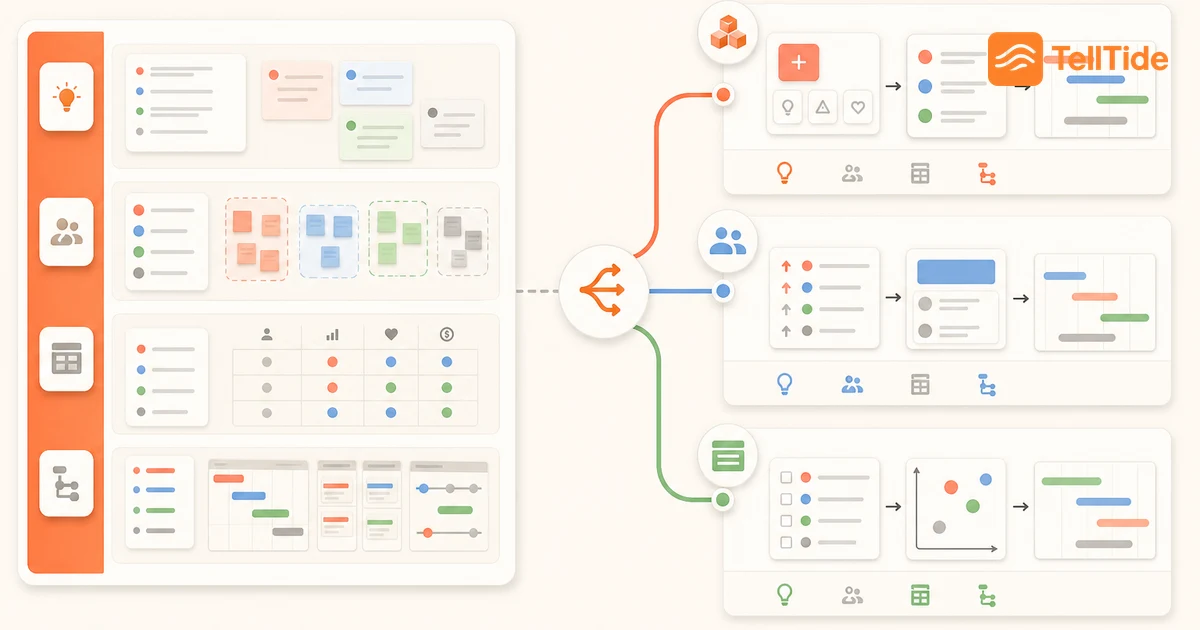
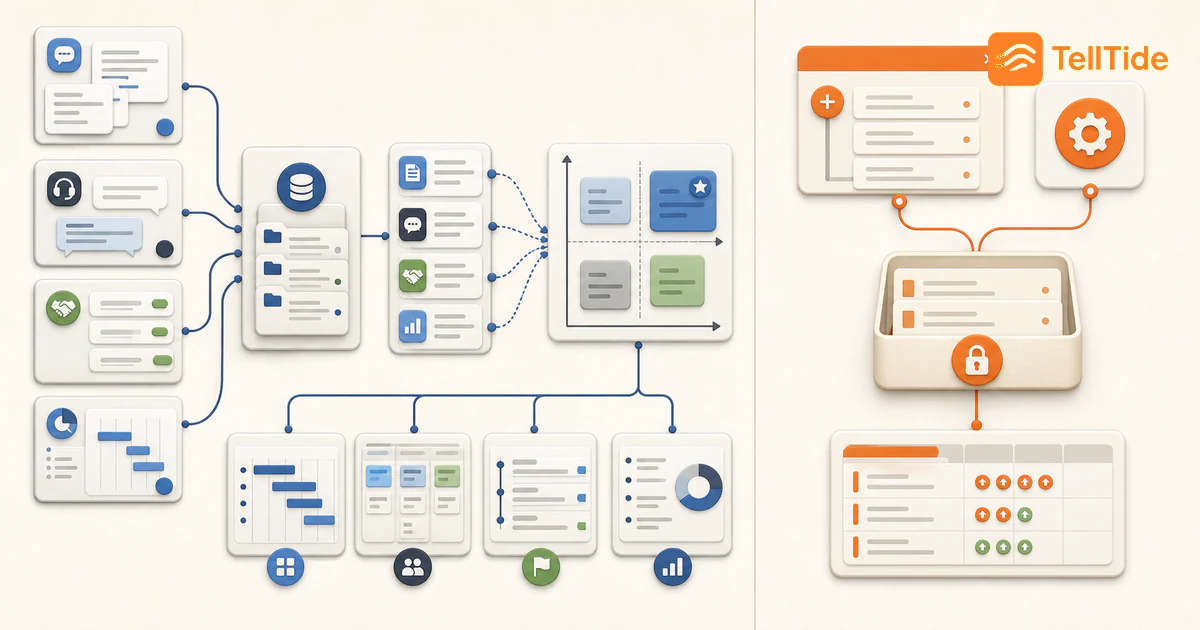
Productboard now presents itself as an agentic product system rather than only a roadmap database. Its Spark AI product agent works across connected feedback, research, competitive context, documents, and product data to synthesize evidence, identify opportunities, and help draft product specifications. Roadmaps and a customer-facing Portal then communicate the resulting direction.
Productboard Spark and discovery compared with TellTide
| Capability | TellTide | Productboard |
|---|---|---|
| Primary job | Collect, triage, and communicate product feedback | AI-assisted discovery, specifications, prioritization, and product planning |
| Inputs | Widget and API submissions with structured feedback types | Feedback, research, documents, competitive context, connected tools, and product data |
| Evidence workflow | Review each submission in a focused inbox | Spark synthesizes connected signals into insights and opportunities with traceable evidence |
| Roadmaps | Curated public roadmap with voting and comments | Dynamic roadmap views plus a customer-facing Portal |
| Best fit | Lean teams needing a feedback system | Product organizations needing discovery and planning infrastructure |
Choose TellTide when feedback is the missing layer
If planning already happens in an issue tracker, a document, or a weekly product meeting, you may only need a dependable way to hear from users. TellTide adds that layer without asking the team to move its entire product process.
The workflow stays concrete: collect the message, identify its type, review it privately, update its status, and publish a roadmap item when public validation will help. For founders and compact product teams, that smaller surface can make adoption easier.
Choose Productboard when connected evidence should drive product work
Productboard is the better match when product managers gather evidence from interviews, support, sales, documents, product systems, and market research—not only a feedback widget. Spark is intended to work across that connected context: clustering signals, surfacing opportunities, and helping create briefs or specifications without separating the output from its supporting evidence.
That value depends on both process maturity and data quality. AI synthesis is useful only when the connected sources are current, access is properly scoped, and a product manager validates the conclusion. If the priority is simply to collect clearer feedback and close the loop, TellTide is more direct.
Compare the systems with one product decision
Choose a recent roadmap question and recreate it in both tools. In Productboard, connect the interview notes, support messages, sales evidence, product documents, objectives, and roadmap views that contributed to the decision. Ask Spark to summarize the opportunity and draft a brief, then check every important conclusion against its evidence. The test is valuable only if your team will maintain those connections after the trial.
In TellTide, capture the relevant customer messages, organize them in the inbox, and publish a qualified request for public validation. This reveals whether the organization needs a connected discovery and planning system or a lighter customer-feedback layer beside its existing planning tools.
Include every regular participant in the evaluation. Product managers may value evidence linking, AI-assisted drafting, and flexible roadmaps, while a founder-led team may prefer fewer fields and faster triage. Review data permissions and source freshness as part of the test: a confident summary built from incomplete context is not a better product decision. The right choice minimizes lost context without creating a process that is more sophisticated than the team’s actual decision cadence.
Count maker seats and preserve source evidence
Productboard's plans distinguish maker seats, contributor access, feedback-note limits and AI usage. Price the roles your team will actually need, including minimum seats on the selected plan. Do not assume a product discovery platform must be more expensive for every small team: Productboard also lists a Free plan.
For an AI-generated brief, inspect the source material behind each conclusion. A useful acceptance criterion is whether a teammate can trace an important recommendation back to the customer evidence and correct it when the source changes. This is a suggested evaluation, not a completed benchmark.
TellTide does not replace linked research or AI synthesis. The Productboard alternatives guide separates those requirements from basic intake.
What two product managers pay for Productboard versus TellTide
Productboard's plan prices are not in the static version of its pricing page, so these figures come from our check on 9 September 2026. Confirm them before buying:
| Productboard | TellTide | |
|---|---|---|
| Pricing model | Per maker (people who manage the workspace) | One flat plan |
| Paid plans | Plus from $19 per maker/month billed yearly ($25 monthly); Business from $59 per maker/month billed yearly ($75 monthly), two-maker minimum | Pro at $19/month or $194/year |
| AI usage | Credits included, with top-up bundles for sale | Not applicable |
Two product managers on Plus come to about $38/month billed yearly; on Business, about $118/month. TellTide is $19/month. Those numbers buy different things, though: Productboard is where product managers plan, and TellTide is where customers tell you what is wrong or missing.
Example: one PM, three products, and a sales team asking for features
Here is an illustrative case. A product manager owns three products. Sales passes on requests from prospects, support forwards complaints, and customers occasionally email ideas. Leadership wants to see why the roadmap looks the way it does.
- Productboard fits the PM's planning problem: requests become insights linked to features, with roadmaps for leadership and for customers.
- TellTide fits the intake problem: a feedback button in each product, so customers report bugs and ideas directly, with page context, into one private inbox.
If the PM's pain is "I can't connect evidence to decisions", start with Productboard. If it is "feedback never reaches me in a usable form", start with TellTide. Some teams run both, but TellTide has no ready-made Productboard integration, so requests move across by hand or through a webhook automation you set up yourself.
Five things to price before choosing Productboard
[ ] How many makers need full access, and does the plan have a minimum?
[ ] Who only needs to view or comment (contributors), and what do they cost?
[ ] How many feedback notes will you store, and is there a limit on your plan?
[ ] How much AI usage you expect, and what top-ups would cost
[ ] Who will keep insights linked to features every week
See the side-by-side pages for Canny vs Productboard and UserVoice vs Productboard.
Comparing Productboard with TellTide? Get TellTide Pro for $19/month flat, add the widget in about five minutes, and test it on your own product.
Questions teams ask before choosing this workflow
How much does Productboard cost compared with TellTide?
Productboard charges per maker: Plus from $19 and Business from $59 per maker/month billed yearly when we checked on 9 September 2026. TellTide is $19/month flat. The two do different jobs, so compare them against the problem you need solved.
Is TellTide a Productboard alternative?
TellTide is a focused alternative for feedback capture, inbox triage, and a public roadmap. It is not intended to replace Productboard’s broader discovery and product planning capabilities.
Which tool is simpler for a startup?
TellTide is designed around a smaller feedback workflow. Productboard becomes more useful when a startup has a formal discovery process and several sources of customer evidence.
Do both products offer a customer-facing roadmap?
Both can communicate plans publicly, but TellTide publishes selected inbox items to a roadmap while Productboard’s Portal is part of a wider discovery and planning system.
Research notes
Sources reviewed
These references support the discussion above. Specific pricing checks are dated in the article; its editorial update date does not imply that every linked page was reverified. Confirm plan availability with each vendor.

Abhijith
Founder of TellTide, writing practical guides about product feedback, feature requests, and public roadmap workflows for SaaS teams.