At a glance
Key takeaways
- TellTide is a fit for widget or API submissions that need private triage before selected requests become public.
- Private boards are also available from competitors; privacy alone is not a reason to switch.
- Compare plan restrictions and migration losses before replacing an established feedback community.
Which replacement solves your actual Upvoty problem?
Start with the reason for leaving. A team that needs a private bug-report intake has a different requirement from a team that needs changelog subscriptions or revenue-aware voting. Choosing a replacement from a feature count can preserve the wrong workflow and introduce unnecessary migration work.
Disclosure and method: This guide is published by TellTide. TellTide appears first for its structured-intake use case, not as an independently ranked overall winner. Competitor pricing and capabilities were reviewed on official public pages on September 9, 2026. We have not run a comparative usability or performance benchmark. Prices below use the billing basis stated beside them; check vendor checkout before buying.
| Shortlist | Best reason to evaluate | Budget consideration | Main decision boundary |
|---|---|---|---|
| TellTide | Reviews, bugs and requests need private triage | Pro required; confirm current checkout amount | Curated roadmap rather than a changelog and notification suite |
| Canny | Feedback arrives through customer conversations | Free tier; paid pricing scales with tracked users | Account for users associated with feedback, not just employees |
| Frill | Ideas should connect to announcements | Startup lists $25/month; review limits and add-ons | Budget for the idea volume and privacy configuration you need |
| Keep Upvoty | Existing voting boards already work | Power lists $15/month on monthly billing | Switching must justify disruption to followers and links |
TellTide: structured intake before public voting
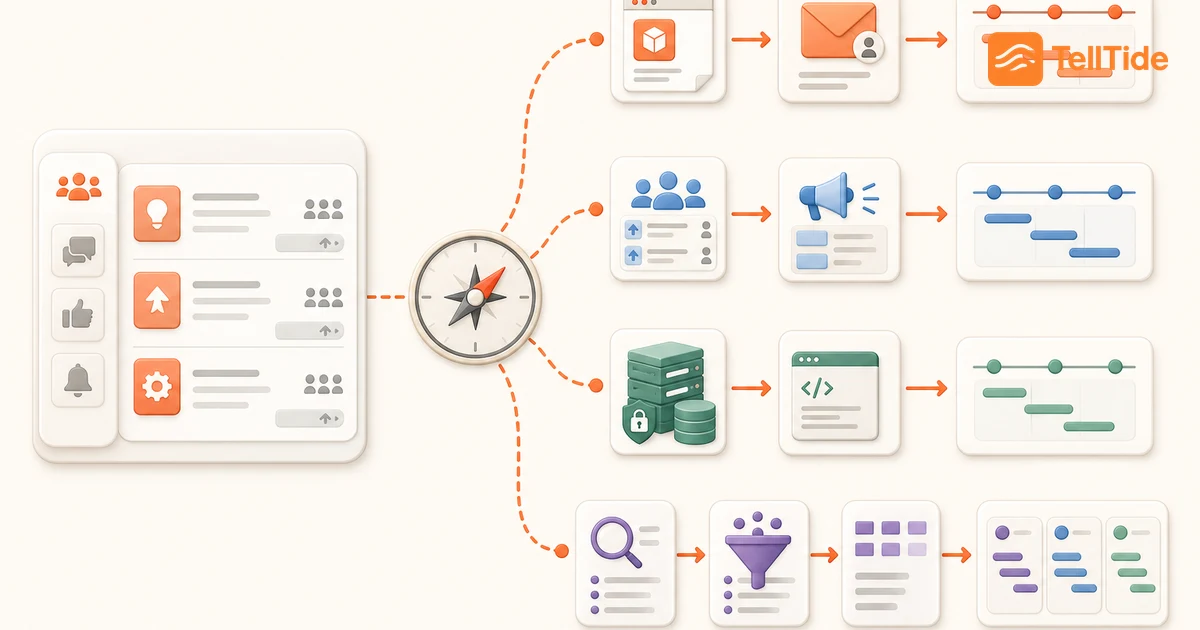
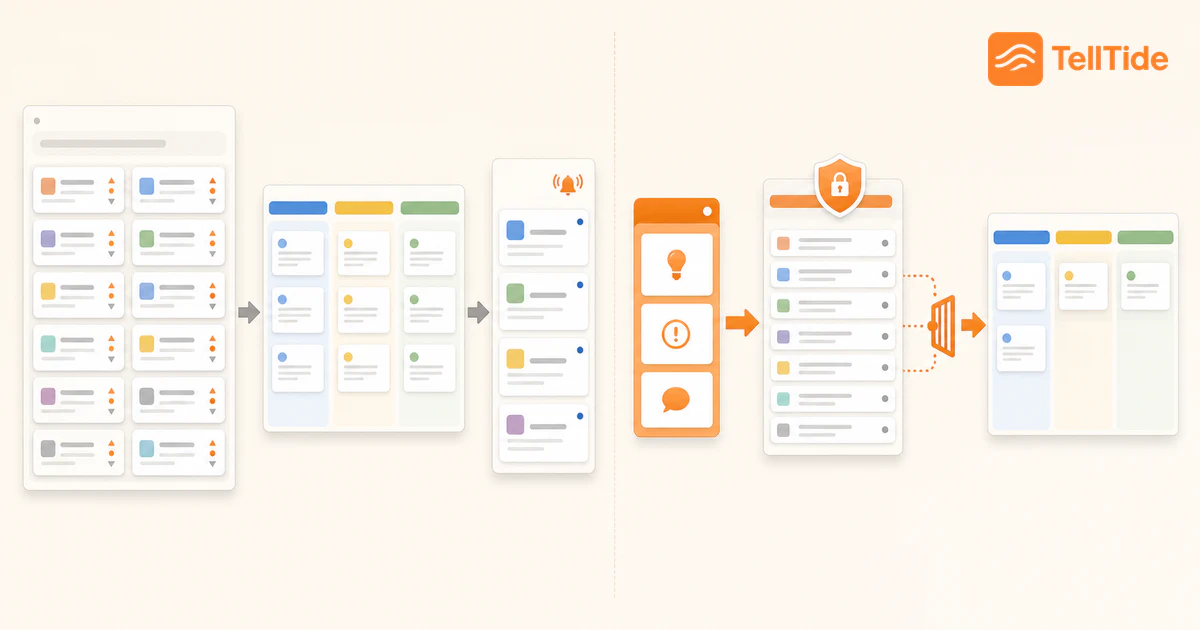
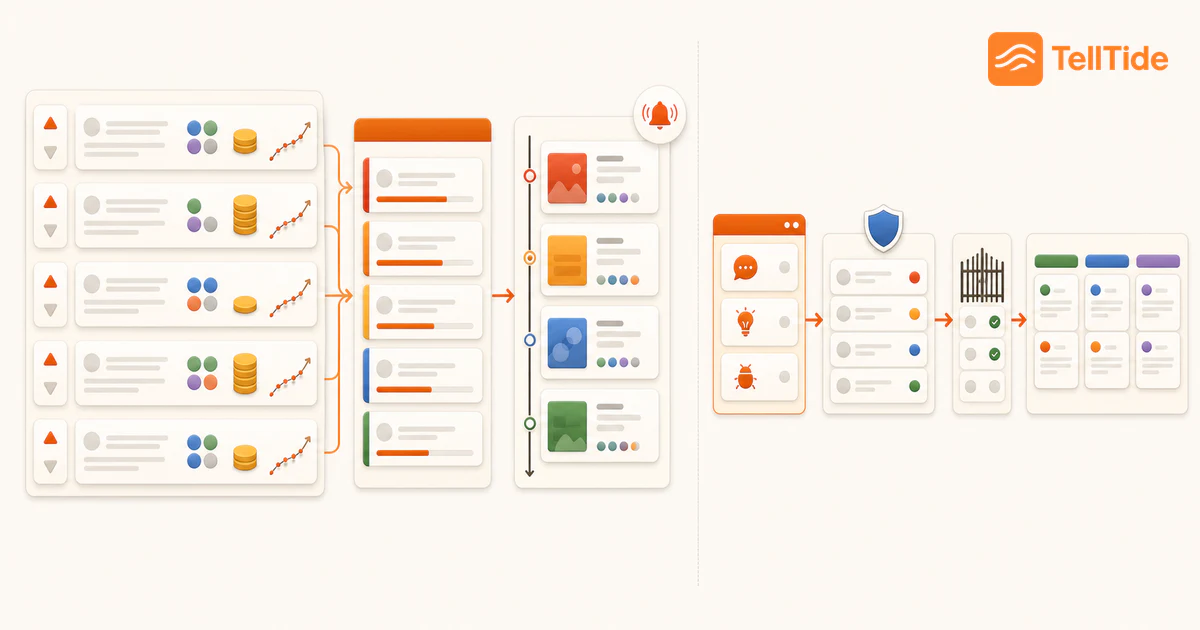
TellTide collects reviews, bug reports, general feedback and feature requests through a widget or submission API. The team reviews the inbox privately and chooses suitable requests for the public roadmap. This is useful when raw reports need clarification or contain context that should not become public discussion.
The distinction is the intake and publication process. Upvoty also has private boards, moderation and a widget. Choose TellTide if the separate submission types and private triage match the way you work; do not choose it on an assumption that competitors cannot protect feedback.
TellTide requires Pro for product use. There is no free trial or free plan. A built-in changelog, automated email notifications and ready-made integrations are not included capabilities here. If those are requirements, keep a broader platform on your shortlist. Read the direct Upvoty comparison for the workflow boundary.
Canny: customer conversations and feedback analysis
Canny's current pricing lists a free plan with 25 tracked users and Pro starting at $79/month billed annually. A tracked user is associated with feedback; it is not simply a paid team seat. That makes forecasted participation a useful budgeting input.
Canny describes automatic capture and triage from customer conversations. Evaluate this option when feedback originates outside a single widget and the team wants to connect evidence across channels. Before switching, estimate how many customers will post, vote, comment or have feedback recorded on their behalf. Its free tier is worth evaluating for a small pilot; do not compare an annual starting rate directly with a monthly plan without normalizing the cost.
Frill: ideas connected to release announcements
Frill's pricing lists Startup at $25/month with 50 ideas and one survey, and Business at $49/month with unlimited ideas and three surveys. Privacy and white-labeling have separate packaging considerations. Confirm the required configuration before treating the entry price as your total cost.
Frill is a candidate when customers should follow ideas through to announcements. The practical question is whether someone on your team will maintain that release communication. If the current problem is simply unreviewed private reports, another customer-facing surface will not fix the operating habit. The Frill comparison explains that distinction in more detail.
When staying with Upvoty is the better decision
Upvoty lists Super at $25/month and Hyper at $49/month on monthly billing. Its plans distinguish release features and project coverage. If your users already follow requests and your team uses the changelog, replacing those relationships carries a cost beyond the subscription.
Write down the specific missing requirement first. If a plan or configuration change solves it, that may be less disruptive than moving. A new tool should improve an identifiable bottleneck, such as submission quality, triage ownership or release follow-up.
Preserve customer context during a switch
Export a sample before cancelling the old service. Check whether it contains post identifiers, comments, voter identities, attachments and statuses. Separately verify whether the destination can import each field. Export availability does not establish import compatibility, and this guide does not promise a TellTide migration utility.
Keep a mapping of old public links to their new destinations. Tell followers where to check progress and whether subscriptions need to be recreated. Start with a small batch of active requests, verify access and visibility, and only then move the remaining material. Preserve historical evidence separately when it cannot be imported safely.
For a wider shortlist, compare the Canny alternatives. For implementation, use the TellTide setup guide before inviting customers into a new workflow.
A short decision worksheet for the final two options
Write down the one reason to change tools, the behavior that would prove improvement and the capability you cannot lose. For example: “Bug reports lack context; a reporter can submit enough detail without a support interview; existing request followers must still find progress.” This turns a vague preference for a lighter product into something observable.
Use the same realistic submissions with each finalist and keep the evaluation notes. Record unanswered questions separately from confirmed limitations. Ask the vendor about plan-specific behavior when documentation is ambiguous rather than turning uncertainty into a negative claim.
Do not cancel the old workspace before validating the replacement path. The TellTide setup guide covers first-submission checks; your migration still needs its own review of historical records and customer links.
Questions teams ask before choosing this workflow
Which Upvoty alternative fits private feedback intake?
TellTide fits teams collecting reviews, bugs, general feedback and feature requests into a private inbox, with selected requests published to a roadmap. Upvoty also offers private boards, so compare the operating workflow rather than privacy alone.
Is there a free Upvoty alternative?
Canny lists a free tier with 25 tracked users as of September 9, 2026. TellTide requires a Pro subscription; it is not a free-forever alternative.
Can I automatically migrate Upvoty votes to TellTide?
This guide does not claim an automatic Upvoty importer. Confirm export fields and destination import support before switching; do not assume voter identities, comments or subscriptions will transfer.
Research notes
Sources reviewed
These references support the discussion above. Specific pricing checks are dated in the article; its editorial update date does not imply that every linked page was reverified. Confirm plan availability with each vendor.

Abhijith
Founder of TellTide, writing practical guides about product feedback, feature requests, and public roadmap workflows for SaaS teams.